The United States does not have one electricity market. It has a collection of regional systems, each with its own generation base, transmission network, weather exposure, demand profile, and market rules. National headlines about AI, data centers, electrification, and grid investment matter. They do not, by themselves, explain where power is tight, where prices are forming, or where investors can access the market.
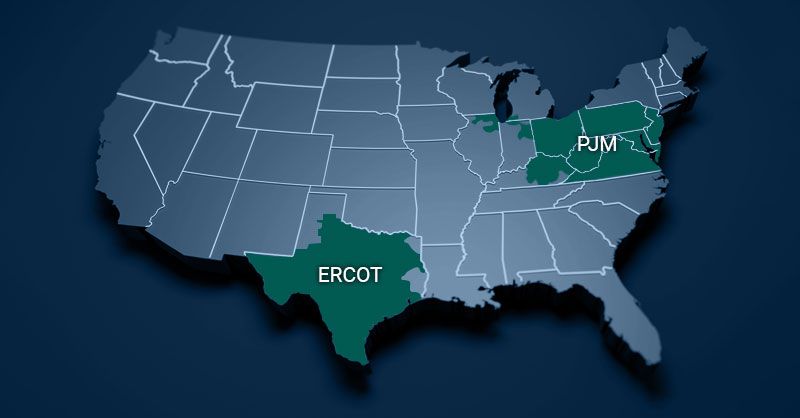
Power demand may be a national story. Power prices are not.
For MWHS, ERCOT—the Electric Reliability Council of Texas—and PJM Interconnection are the two focal markets. Each has transparent wholesale price formation and established listed futures benchmarks. More important, each brings together four features that do not always coexist: visible structural pressure, identifiable regional price signals, established futures markets, and access through standardized contracts. That combination makes ERCOT and PJM more than regional grid stories. They are the principal markets through which investors can evaluate—and obtain futures-based exposure to—U.S. wholesale electricity pricing.
ERCOT: Texas Sets Its Own Conditions
ERCOT serves most of Texas and is largely electrically separate from the two major U.S. interconnections. The distinction is consequential. When Texas demand rises sharply or available supply becomes constrained, ERCOT has limited ability to draw substantial volumes of electricity from neighboring systems. Conditions inside the state therefore carry unusual weight in wholesale price formation.
Texas is adding demand from several directions at once: population growth, industrial development, large commercial facilities, and data-center construction. ERCOT’s planning materials have reflected a sharply higher long-term load outlook, with a meaningful portion tied to proposed large-load facilities. Forecasts are not price predictions. They do show why the relationship among load growth, generation development, transmission capability, and reserve conditions has become a central market question.
ERCOT uses locational pricing. Electricity does not carry a uniform value across the state at every moment. Price differences emerge when transmission limits make it difficult to move lower-cost generation to a particular area, or when local supply and demand conditions diverge. A statewide demand forecast supplies context; the economic effect is ultimately local.
ERCOT is therefore more than a Texas growth story. It is a wholesale market in which weather, load, fuel availability, generation outages, and transmission constraints can be reflected directly in real-time and forward power prices.
PJM: Scale Does Not Eliminate Constraint
PJM operates across all or parts of 13 states and the District of Columbia. It is one of the largest wholesale electricity markets in the country, with day-ahead and real-time energy markets, a forward capacity market, ancillary-service markets, and transmission-related pricing mechanisms.
Its scale creates a different market picture from ERCOT’s. PJM has a broad, interconnected footprint and more avenues for moving power across regions. It also has a layered set of price signals. Day-ahead and real-time prices reflect current market conditions. Capacity auctions establish prices for resources intended to support future reliability. Transmission constraints can still create meaningful differences within the larger footprint.
Northern Virginia illustrates why PJM requires local analysis despite its scale. The region is one of the world’s largest concentrations of data centers, placing a substantial source of new load within PJM. Serving that demand is not merely a question of how much electricity the overall system can produce. It depends on where generation is located, whether transmission can deliver it, how quickly projects can interconnect, and how the market assesses future resource adequacy.
PJM’s size provides flexibility. It does not make the market uniform. The demand outlook in Northern Virginia can have different implications from conditions in western PJM or elsewhere in the footprint. A large regional grid still produces regional price signals.
Two Markets, Two Forms of Price Discovery
ERCOT and PJM are often grouped together because both sit at the center of U.S. electricity futures. The comparison is useful because their differences are material.
ERCOT’s largely isolated structure places greater emphasis on conditions within Texas. PJM’s interconnection and capacity construct create a broader, more complex set of market signals. ERCOT is often assessed through Texas weather, load growth, available supply, and transmission constraints. PJM requires attention to energy pricing, capacity outcomes, transmission development, and the geography of large-load additions.
Electricity is difficult to store economically at system scale in the way many other commodities can. Power must be produced, delivered, and consumed as the system requires it. When supply, demand, or transmission conditions fall out of balance, that pressure can register quickly in spot prices and in expectations embedded in forward markets. Listed ERCOT and PJM futures were developed in part to help commercial participants manage regional price risk. They also provide standardized benchmarks through which investors can obtain futures-based exposure to forward wholesale power prices.
This is where the Power Shift thesis becomes observable. Demand growth, transmission bottlenecks, changes in available generation, and regional load concentration are not abstract inputs. In ERCOT and PJM, they can affect the daily mechanics of wholesale power pricing and the expectations embedded in forward markets. The relevant question is not whether a national electricity theme exists; it is where those conditions are becoming material enough to register in a specific market.
The Skylar Electricity Futures ETF (NYSE Arca: MWHS) Fits
MWHS is not a broad energy-theme fund. The Skylar Electricity Futures ETF (NYSE Arca: MWHS) seeks capital appreciation primarily through investments in U.S. electricity futures contracts, with a primary focus on ERCOT and PJM—two defined wholesale markets rather than a collection of companies tied indirectly to the power system. The intended exposure is to regional electricity-price dynamics, not to a general energy narrative.
The Fund’s market focus does not represent a forecast about any particular weather event, grid condition, or power-price outcome. Electricity futures are specialized instruments and can be volatile. Their prices may be affected by regional weather, fuel costs, generation availability, reserve conditions, congestion, transmission constraints, liquidity, and changes in market or regulatory structure.
ERCOT and PJM provide the clearest entry point for understanding what makes electricity distinct: not a national abstraction, but a set of regional markets in which the economics of power are priced every day.
Important Information
The Skylar Electricity Futures ETF (NYSE Arca: MWHS) seeks capital appreciation primarily through investments in U.S. electricity futures contracts. The Fund is subject to substantial risk, including commodity futures risk, derivatives risk, market volatility, regional concentration risk, liquidity risk, and regulatory or market-structure risk. Because the Fund focuses on electricity futures in ERCOT and PJM, its performance may be significantly affected by regional weather events, fuel input costs, transmission constraints, grid conditions, and changes in supply-demand dynamics.
An investment in MWHS is not a bank deposit, is not insured by the FDIC or any other government agency, and may lose value. Past performance does not guarantee future results. Investors should consider the Fund’s investment objectives, risks, charges, and expenses carefully before investing. The prospectus and summary prospectus contain this and other information and should be read carefully before investing.
Investors should consider the investment objectives, risks, charges and expenses carefully before investing. For a prospectus or summary prospectus with this and other information about the Fund, please call (888) 806-6567 or visit the website at https://skylaretfs.com/investor-materials. Read the prospectus or summary prospectus carefully before investing.
The Fund is distributed by Foreside Fund Services, LLC. Exchange Traded Concepts, LLC serves as the investment advisor of the Fund. Skylar Capital Management, LP serves as sub-advisor of the Fund. Foreside Fund Services, LLC is not affiliated with Exchange Traded Concepts, LLC, Skylar Capital Management, LP, or any of its affiliates.
Risk Disclosures:
Investing involves risk, including possible loss of principal. There is no guarantee the Fund will achieve their stated objectives.
New Fund Risk. The Fund is new and currently has fewer assets than larger funds, and like other new funds, large inflows and outflows may impact the Fund’s market exposure for limited periods of time. This impact may be positive or negative, depending on the direction of market movement during the period affected. Additionally, because the Fund has fewer assets than larger funds over which to spread its fixed costs, its expense levels on a percentage basis will be higher than that of a larger Fund.
Non-Diversification Risk. The Fund is non-diversified under the 1940 Act, meaning that, as compared to a diversified fund, it can invest a greater percentage of its assets in securities issued by or representing a small number of issuers. As a result, the performance of these issuers can have a substantial impact on the Fund’s performance.
Commodities Risk. Commodity prices can have significant volatility, and exposure to commodities can cause the value of the Fund’s shares to decline or fluctuate in a rapid and unpredictable manner.
Commodity Regulatory Risk. The Fund’s use of commodities subject to regulation by the CFTC has caused the Fund to be classified as a “commodity pool” and this designation requires that the Fund comply with CFTC rules, which may impose additional regulatory requirements and compliance obligations.
Futures Investment Risk. The Fund’s rolling strategy involves the replacement of shorter dated futures contracts with longer-dated futures contracts. The net asset value of the Fund may be adversely affected by the cost of rolling positions forward where prices of the futures contracts with later expiration dates are higher than those with earlier expiration dates, which would create a negative “roll yield” known as “contango.”
Derivatives Risk. The use of derivative instruments involves risks different from, or possibly greater than, the risks associated with investing directly in securities and other traditional investments.
Electricity Futures Regulatory Risk. The wholesale electricity markets operated by ERCOT, PJM, and other RTOs and ISOs are subject to extensive regulation, and the rules, protocols, and market structures governing these markets may be modified or amended at any time.
Premium/Discount Risk. The market price of the Fund’s shares will generally fluctuate in accordance with changes in the Fund’s net asset value as well as the relative supply of and demand for shares on the Exchange. The Fund’s investment adviser cannot predict whether shares will trade below, at or above their net asset value because the shares trade on the Exchange at market prices and not at net asset value. Price differences may be due, in large part, to the fact that supply and demand forces at work in the secondary trading market for shares will be closely related, but not identical, to the same forces influencing the prices of the holdings of the Fund trading individually or in the aggregate at any point in time. During stressed market conditions, the market for the Fund’s shares may become less liquid in response to deteriorating liquidity in the market for the Fund’s underlying portfolio holdings, which could in turn lead to differences between the market price of the Fund’s shares and their net asset value and the bid/ask spread on the Fund’s shares may widen. Additionally, the Fund’s shares may trade at a significant premium or discount to their net asset value in the event that a lead market maker is unwilling or unable to make a market in the Fund’s shares.
Net Asset Value (NAV). NAV per share for the Fund is computed by dividing the value of the net assets of that Fund (I.e., the value of its total assets less total liabilities) by its total number of shares outstanding. Expenses and fees, including management and distribution fees, if any, are accrued daily and taken into account for purposes of determining NAV. NAV is determined each business day, normally at 4:00 p.m. Eastern Time.
Market Price. The current price at which shares are bought and sold.
The Electric Reliability Council of Texas, Inc. (ERCOT) is a nonprofit organization that ensures reliable electric service for 90 percent of the state of Texas. The grid operator is regulated by the Public Utility Commission of Texas and the Texas Legislature. As of March 2026, ERCOT reported that it offers over 104,000 megawatts of generation capacity and manages the flow of electric power to more than 27 million Texas customers, representing about 90 percent of the state’s electric load.
PJM Interconnection LLC (PJM) is an RTO that coordinates the movement of wholesale electricity in all or parts of Delaware, Illinois, Indiana, Kentucky, Maryland, Michigan, New Jersey, North Carolina, Ohio, Pennsylvania, Tennessee, Virginia, West Virginia, and the District of Columbia. As of December 31, 2024, PJM reported that it provided electricity to over 67 million people and offers over 182,000 megawatts of generation capacity, generating over $51.7 billion in annual billings.